
Estimated time: 6 min
Learning objectives
By the end of this lesson, you will be able to:
- Read the IB's own objectives as a checklist of what examiners reward
- Show intellectual exploration and genuine personal interest in your topic
- Turn the IB's research-process instructions into a clear direction for your EE
Is it hard to get an A in the extended essay?
It's hard to get an A in your extended essay. Very hard.
…is something you'll never hear me say.
Is it challenging? Yes. But c'mon, you're balancing 6 subjects — 3 HL and 3 SL — as well as IAs for every single one, while balancing college applications and a personal life. You can easily get an A in your EE if you curate your approach.
Let's look at how we can do that using everything the IB has given us. I'm gonna give you something so useful that's gonna completely switch up your approach.
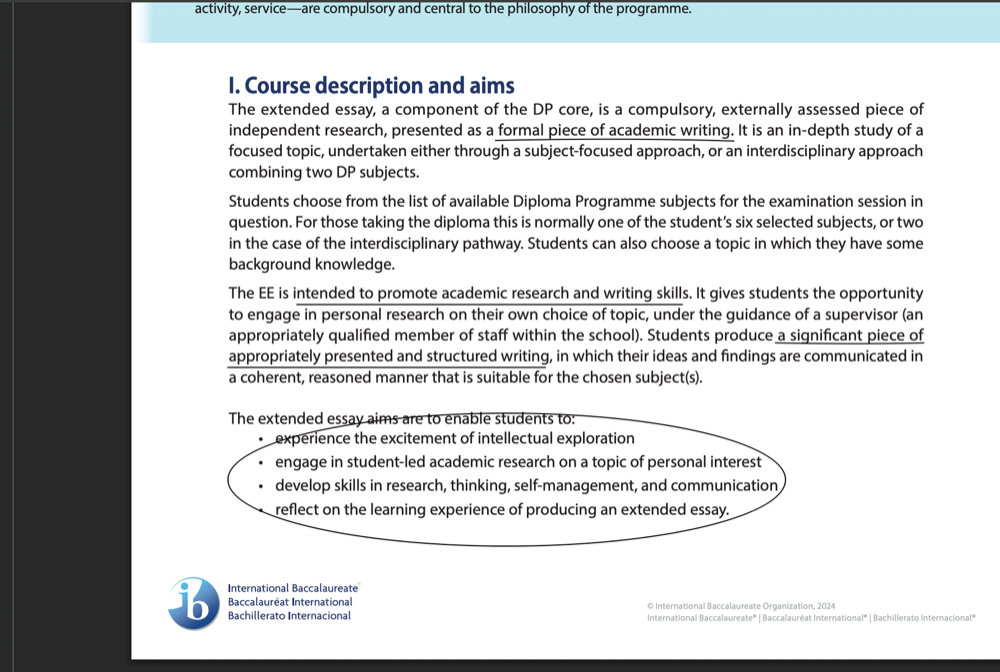
They constantly give us clues that we can accumulate as our 20 percent: a formal piece of academic writing and how the EE is intended to promote academic research and writing skills.
Now this may seem obvious and most students may just glaze over it, however it gives us our base — the approach that contributes to making a stellar extended essay. This approach and mindset alone can help you excel in your essay and secure that A.
The single best way you can write your extended essay is not as a student writing an extended essay for the IB, but rather as an award-winning academic who is writing their 20th academic paper that is expected to finally get them the Nobel for the discoveries made and the quality of research.
This mindset shift — from writing it just as another student to actually believing this is not for school but rather an actual research paper you are publishing out in the world — completely changes the way you as a student write the essay and simultaneously achieves the quality of work that IB actually expects and almost makes it effortless. This is where most students may find it hard. They underestimate the quality expected in an extended essay because it's not another 4000-word essay — it's a research paper. If you write your extended essay as if it were your first research paper in the world, you would automatically go well over the 28 you need to get an A effortlessly.
Okay, now analysing the circled portion:
Experience the excitement of intellectual exploration
The EE does give you an amazing opportunity to explore anything you love. However, even in the rare case you don't love anything and just wanna be done with the EE, then you need to be able to show intellectual exploration in your EE. This goes for whether you write about something you like or don't like. It doesn't matter until I — and more importantly the examiner — can see it in your EE. We'll go into how to show intellectual exploration later on in the following modules, but for now let's continue analysing this piece of gold given to us by the IB.
Engage in student-led academic research on a topic of personal interest
Once again, here whether or not you're choosing an actual topic of personal interest doesn't matter, but it needs to look like
- you're really passionate about it
- it's so niche it could only possibly belong to you.
This means incorporating hobbies and activities you pursue on a daily basis into your area of exploration. This doesn't mean you need to be a piano or sports prodigy, but rather if you're into video games or ballet or some kind of sport, the beautiful thing about your EE is that you can literally centre your EE around that one single thing you're passionate about. This could even be eating snacks if you're into that, or flowers. I'll go into how you can use small things you're passionate about in your EE and frame the most creative research question.
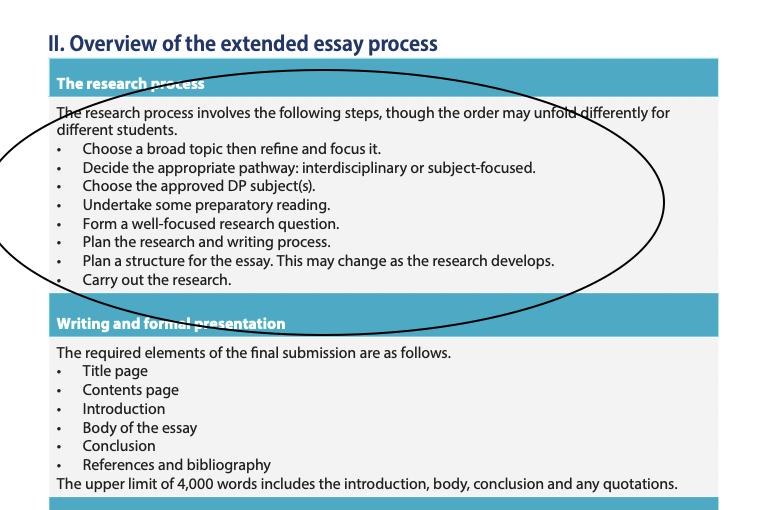
IB gives us exactly what we need to do and what they expect from us to get an A. I'm going to break down every single aspect they've touched upon in detail in the further modules and how we can use this to optimally come out with the best EE possible. While these instructions give us a direction to follow, I'm going to start by detailing each and every point of the research process.
Choose a broad topic then refine and focus it
This points back to a broad interest of yours that I mentioned earlier. don't use ChatGPT or any AI for that matter. The only reason I say this is because it's easier to delve into research for a topic that you've curated from scratch and something that you actually like, instead of using something that ChatGPT gives you. AI is not creative, it's repetitive — it recycles and regurgitates information, and the chances of you having a well-thought-out research question decrease, which pulls us further away from what actually gives you that A in your extended essay.
When IB asks you to choose a broad topic and refine it, it means choose anything — literally anything. Your extended essay is a reflection of you and how you tie in topics to provide a fuller exploration.