
Estimated time: 5 min
Learning objectives
By the end of this lesson, you will be able to:
- Choose an EE subject that balances genuine interest, academic strength, and how EE-friendly it is
- Use Clastify to study high- and low-scoring essays in your subject before you commit
- Separate your IB subject from what you're genuinely interested in — then connect the two
A lot of the time you may be interested in a topic or a subject, but the criteria for that specific subject may be slightly more competitive or require more detail than another topic. For example, it's known that doing your EE in Business would render more lenient grading in most cases, as the exploration required for most RQs in Business is more straightforward than a mathematical exploration, in which the justification would require more depth and detail.
It's hence important to definitely use your discernment, but since I don't want to leave you with nothing, here's an image that would help.
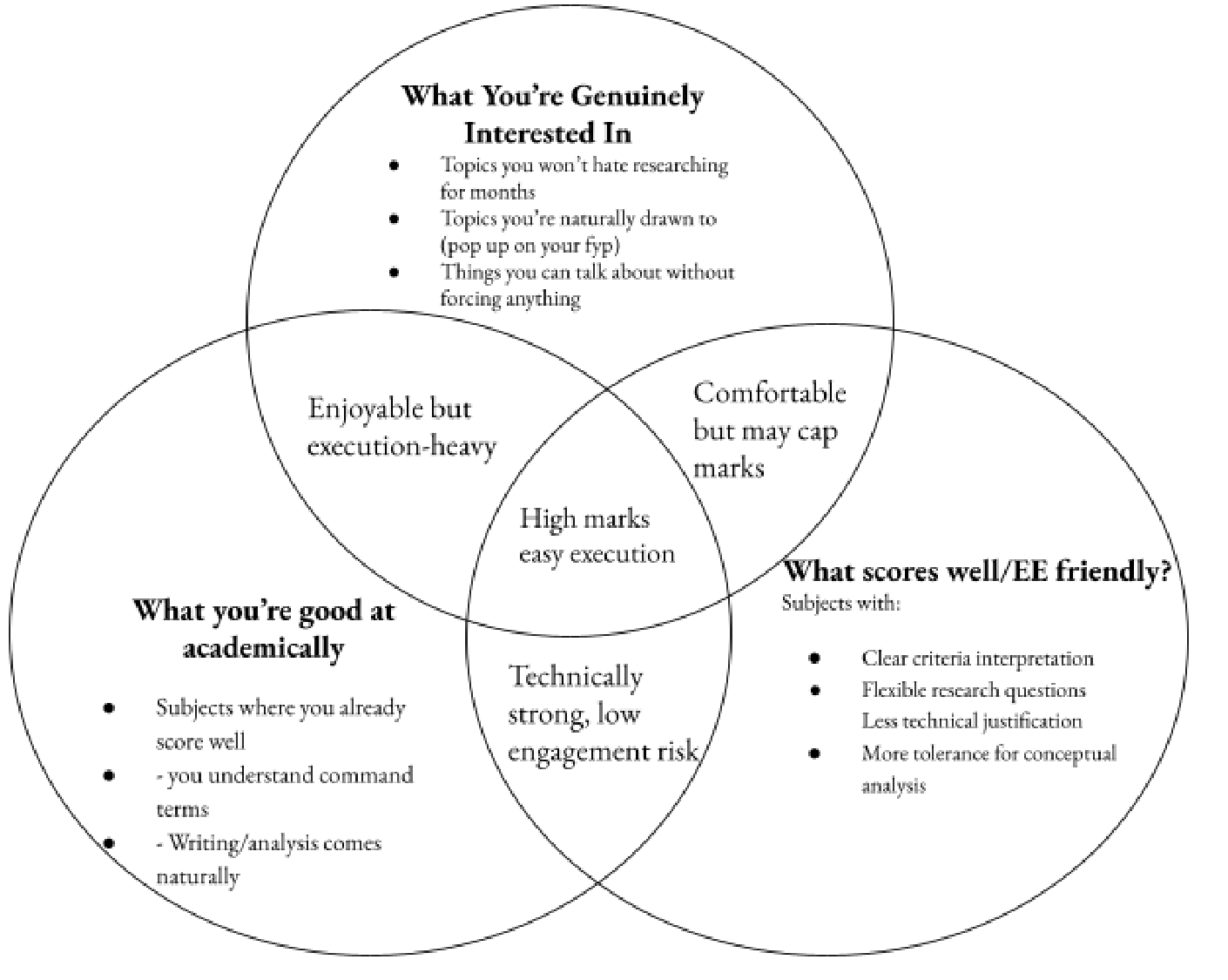
Your EE subject should sit as close to the centre as possible. If your topic lives on the edges, expect higher stress for the same marks.
Now what do I mean by EE-friendly?
When you're doing the IB, you're lucky enough that years of students and IB alumni have their experience to support you. So look at Clastify for your specific subject and analyse the good and the bad essays. Talk to those who've done it before and ask for advice on approaching that topic. Here, Clastify is going to be your best friend, so down below I've created a How to: Clastify (efficiently and not waste hours).
Clarification
Your subject is going to be different from your “what you're genuinely interested in.” Your subject is IB-related. You may be technically skilled at Lang & Lit and may score effortlessly. That doesn't mean you choose that as your EE topic. Similarly, what you're genuinely interested in isn't an IB subject — it's any topic that you're interested in. Like I mentioned: things that pop up on your FYP (fashion, culture, pop, arts, politics, slime videos, literally anything).
How do you think of your EE as an academic?
Your mindset towards your EE has to be less of “I'm an IB student and just wanna get done with this 4000-word essay so I can go to a house party” and more of “I'm a critically acclaimed, award-winning author who's been asked to present groundbreaking research on insert your wonderful RQ by a particular deadline.”
Now it doesn't matter if you are the first one. What matters is if your EE gives the second one to your examiners. The way you do that is by choosing your subjects right. You don't have to pretend to care about your EE — it's much easier and more fun if you actually do care about it.
So to think of your EE as an academic means two things:
- Your formatting and organisation are so perfect they think you're an academic.
- Your passion and findings in your paper don't give generic EE.